Reversing numbers and letters is a thing of the past
Does your child reverse letters and numbers?
Do you write with your left or right hand? This is a preference your brain and body has decided is the strongest for this particular task. It is your “dominant hand.” You also have a dominant foot, for kicking a football, a dominant ear you use when listening on the phone, and dominant eye. We do use both sides of our body but when choices have to be made your body knows best.
Knowing whether your child’s dominant eye is right or left can answer a lot of questions regarding the way they read or write. Why, you ask? Because a child who is left eye dominant scans and writes text from right to left under stress. This often shows up as letter and number reversal when learning to write.
The student who reverses letters
Nicholas, aged 9, is such a child, he is left eye dominant and used to scan from right to left. When he first came to see me, though right handed, he would write most of his numbers and many letters in reverse. He could not count successfully or remember his place when counting out loud, nor did he understand how to read numbers when written.
The educational psychologist had informed us his working memory was poor, in the 8th percentile (i.e. 92% of children his age had stronger working memories). However, there was no way we could successfully address this until his sensory world (visual/auditory system) was taking in information accurately.
When Nicholas was 6 years old we started with this sensory aspect, in silence. The non-verbal element forced him to prioritise and focus on visual information. So began the journey of tracking, visual prioritisation and the sequencing process which went along with it. Each aspect of sequencing, logic and the understanding of numbers progresses cumulatively from one to the next. My approach is that you can improve working memory through a systematic method of counting forwards and counting backwards. The cognitive load when counting backwards is an incremental step on improving working memory. How can you improve Working Memory, which demands high energy from the brain, when you struggle to process sensory input? This was our starting point.
Directing the body through rhythm
Nicholas has symptoms of ADHD (attention deficit hyperactivity disorder) and ASD (autism spectrum disorder) also known as AuDHD. It was difficult to calm him down enough to be able to teach him because of this, so we started slowly. Initially, he would always cry for his mum and cling on to her when she attempted to leave the room. He also could not catch nor throw. The visual-motor integration between his hands and eyes were such that there was no muscle control in either one, let alone both working together.
At first, all our work was done sitting down, with Nicholas on the balance board and myself on the floor, in a face-to-face setting. Sitting on the board allowed him to rock from side-to-side which was soothing and also helped keep him in one place. There was a lot of preliminary work to get to a level of cooperation . Once we had controlled both his behaviour in the session and allowed him to experience rhythmic flow we moved onto the first of the Bal-A-Vis-X exercises, “one-bag-square,” then to the second “two-bag square.” Overlapping with the rhythmic pace of the transfer between ourselves and each other, we worked on days of the week, months of the year as well as counting forwards and backwards. The rhythm kept his distractions at bay, forcing him to stay focused. We did these simple exercises of rhythm and movement once a week for 5 months, progressing to standing on the balance board. This rhythm helped him to regulate his emotions, and he started to arrive at the sessions much calmer. Next came visual perception exercises to enable Nicholas to understand letter direction. Visual perception can be described as how the brain interprets what the eyes see.
Improving visual perception
Visual perception is not solely to do with how the brain sees letters, but how it sees things in relation to one another. I gave Nicholas simple drawings on graph paper to copy. The paper allowed him to see the direction, proportion and length of a line in one square; he transferred what he saw onto his own graph paper. He was delighted when a picture emerged. The drawing was combined with more formal right and left body anchoring and anchoring of symbols, both letters and numbers. His number sense greatly improved as did his reading comprehension and handwriting.
Fast-forward three years. The videoclip of Nicholas drawing a picture starting with the word “BOY” demonstrates a combination of all the skills he has gained; letter direction, visual prioritisation, sequencing and visual perception as well as figure ground discrimination.
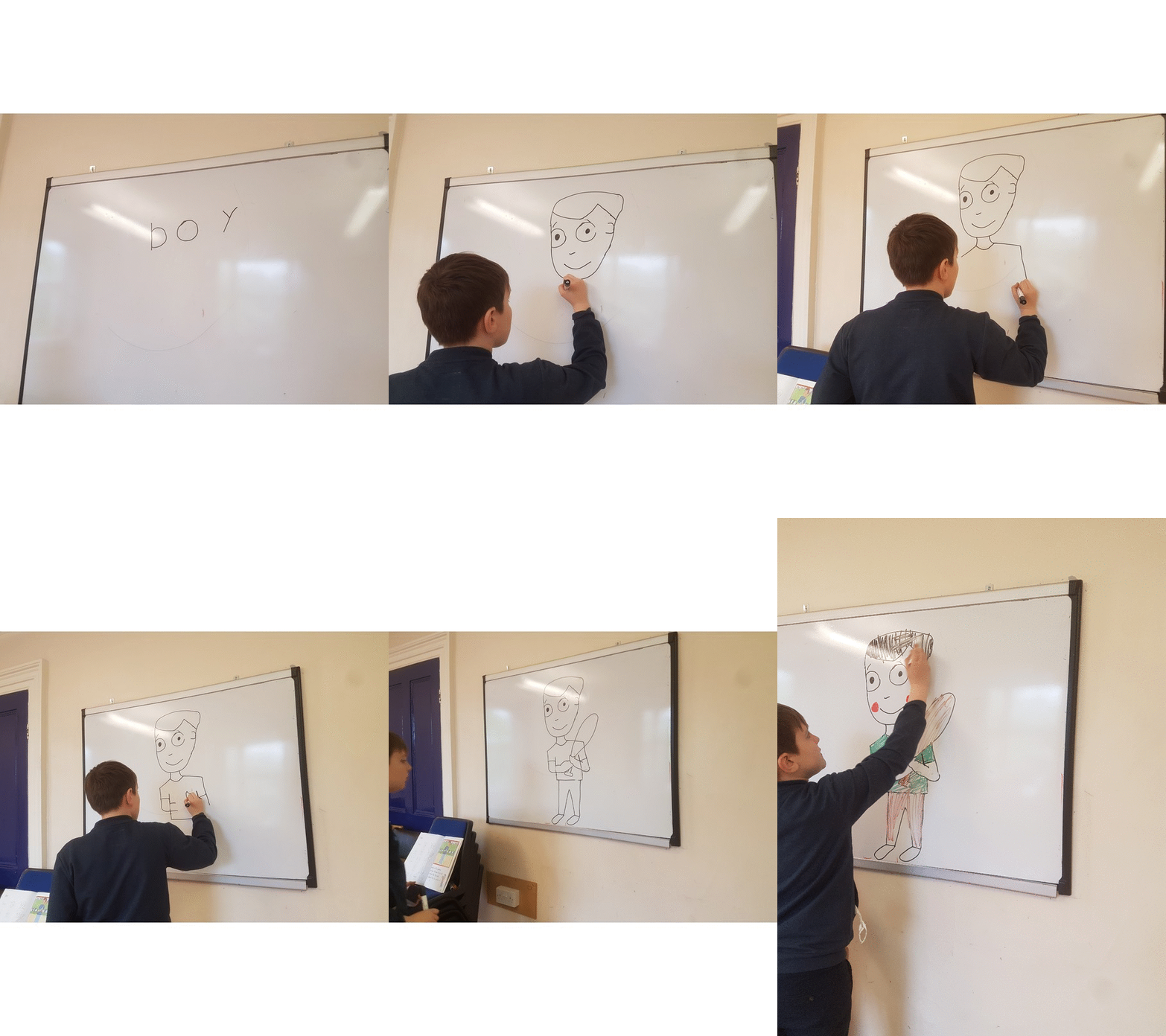
Nicholas also displays sustained concentration, an ability to keep calm when making a mistake, and finishing the task to the end whilst having fun! From the onset we have continually combined all tasks with rhythmic ball and bag exercises. It is a significant achievement having gone from an inability to throw or catch effectively, to being able to bounce two balls with one hand.

By working with the primary senses of vision, hearing and movement, body awareness can be achieved thus lifting the brain-fog, this is the key, AuDHD is not something anyone can or should cure but we can re-set the system one day at a time, so that the symptoms are more manageable.
This article is written with the kind permission of Nicholas’ parents, James and Ilona.
Dyslexia? Dyspraxia? ADHD? ASD? Speech & Language? Developmental Delay? Anxiety?
Is every school day a struggle? As a parent, you may feel exhausted and on this journey alone. Each year you see the gap getting wider. You need to do something - change the approach, help your child learn for themselves, find a way to turn this around - to help while you can - do this NOW. the first step is free.
