Why does my child apply too much pressure when writing?
How do primitive reflexes affect handwriting?
When learning to write, children must develop many skills, including strong core and neck muscles to maintain good posture. Gross motor skills (arm muscles) need to develop before handwriting; fine motor skills can progress naturally. Fine motor coordination in the fingers for a tripod grip, along with wrist agility, makes up one third of writing skills. Other factors at play include hand-eye coordination during mark-making, understanding two-dimensional orientation, and body awareness.
When a child has persistent difficulty producing neat handwriting, and no amount of worksheets can resolve it, a clinician may diagnose your child with DCD (Developmental Coordination Disorder) or, more specifically, dysgraphia, a handwriting difficulty.
Signs your child may have a handwriting difficulty
trouble forming a tripod grip
inconsistent letter size
trouble writing on the line
difficulty writing from the margin
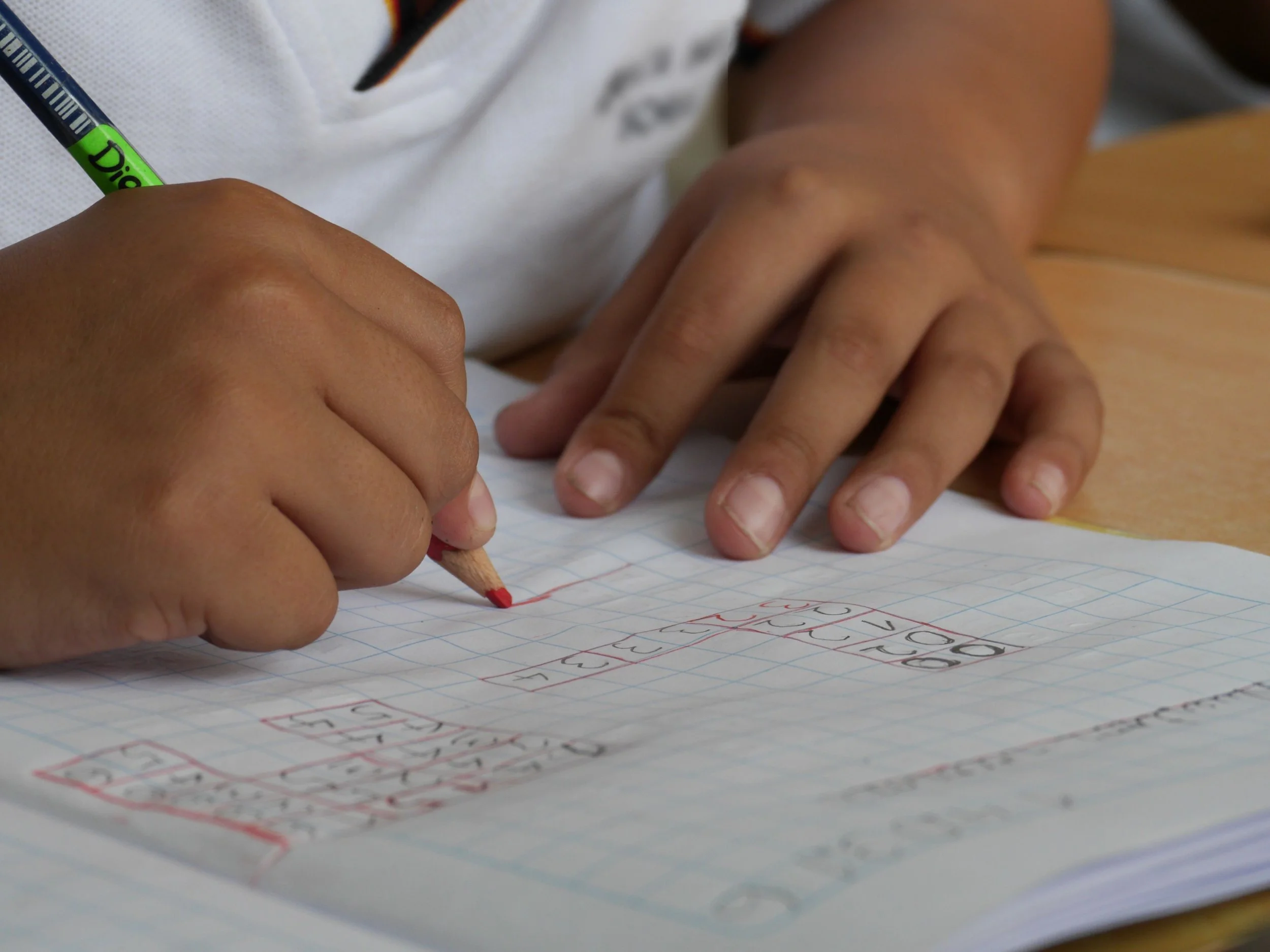
pressing too hard when writing
combined challenges
How Robinson's Hand Grasp reflex affects pencil grip.
Toddlers first hold a pencil in a dagger grip. The fist wraps around the writing instrument, and the child scribbles. Once the brain differentiates and identifies each finger through pincer-grip activities, the next stage of pencil grip development follows. Sometimes children miss a developmental stage and cannot form the correct hand and finger position to hold a pencil with ease. In our one-to-one therapy, we then work on a reflex pattern called Robinson's Hand Grasp. These exercises are unique to a programme called MNRI, and they help a child move through the sensory and motor patterns of grasping and holding. Sometimes the grasp is weak; other times, it is too strong. Follow-on hand and finger sequencing exercises help the child's brain map each finger as an individual part of the hand. Once the child builds these finger-sequencing skills, they can feel the writing instrument better and position their fingers correctly in the tripod grasp.
“Crawling lets a child move freely and, for the first time, focus their eyes on distant objects.”
How the Symmetric Tonic Neck Reflex (STNR) affects letter size and writing on the line.
Sometimes children do not write letters with a consistent size within the same word or sentence. Their words may drift diagonally across the page, not anchored to the lines. This is partially caused by an inability to form letter shapes correctly due to limited wrist and finger dexterity. Robinson's Hand Grasp helps here too, but another reflex plays a part: the Symmetric Tonic Neck Reflex (STNR). This reflex develops during the crawling stage of infancy. Crawling lets a child move freely and, for the first time, focus their eyes on distant objects. Soon they can focus on things far away as well as close by, and they begin to use binocular, convergence and divergence eye skills. When these skills fail to develop fully, a child struggles to use focal attention to write symbols consistently, and their letters vary in size.
Working on the STNR helps a child move their eyes more smoothly, so they can track the pencil without losing their place or focus. A child's hand position can also hide the pencil. They then write without seeing their letters or the lines on the page, because they see only the back of their hand, not the pencil tip.
“Some children who cannot cross these midlines turn the book to the side to avoid crossing.”
How the Asymmetrical Tonic Neck Reflex (ATNR) affects sticking to the margin.
Writing from the margin relies on the convergence skills that develop with the STNR, and on crossing the visual midline to move the eyes from left to right. Some children cannot move their eyes smoothly from left to right without getting stuck or tired. Some children who cannot cross these midlines turn the book to the side to avoid crossing. They use one side of their body instead of moving properly from left to right.
By working on the Asymmetrical Tonic Neck Reflex (ATNR), we can help the child move their writing hand across the page and return to the margin each time, so their eyes and hand cross the body's midline.
How the Babkin Reflex affects writing pressure.
Some children press too hard when they write. You can feel the indentation on the back of the paper, and sometimes the marks are so heavy they go through several sheets. This problem is difficult to solve.
The work starts with Robinson's Hand Grasp, which helps the fingers sense the pencil without applying so much force. This may resolve the problem entirely, but in my experience, it is one piece of a larger puzzle where more Primitive Reflexes need to be addressed.
In addition to looking at the above reflexes, we need to address the Babkin Reflex, which connects the hands and mouth. Children with a retained Babkin Reflex may stick their tongue out when writing, clench their jaw or grind their teeth. Others do none of that and simply rush. One possible reason for rushing is that the sensations in their mouth, throat and jaw are too distracting. By integrating this reflex, the child will experience less tension when writing, preventing them from writing with such heaviness.
Finding the root cause of handwriting difficulties.
Often there are more problems than those described here. A child may write poorly because they struggle with spelling due to phonological awareness. Other times, they lack knowledge of letter directionality, reverse their letters, or lack confidence entirely.
Handwriting difficulties can be like a tangled ball of string. As you start to unravel it one way, you may reveal more threads knotted within it. Only by treating each child's challenges as an individual case study can we identify the root cause of the difficulty and fully untwine the string.
Dyslexia? Dyspraxia? ADHD? ASD? Speech & Language? Developmental Delay? Anxiety?
Is every school day a struggle? As a parent, you may feel exhausted and on this journey alone. Each year you see the gap getting wider. You need to do something - change the approach, help your child learn for themselves, find a way to turn this around - to help while you can - do this NOW. the first step is free.
